During Printing SA’s recently held Business Leaders Conference, Musa Kalenga, Group CEO of Brave Group and co-founder of Bridge Labs, guided attendees through his presentation ‘The Complexity Dividend: Why Africa’s Complexity is Advantage to Print.’
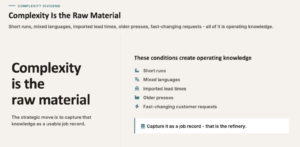
He emphasised on the idea of complexity, how it is conveyed as negative, and how embracing such could be uniquely positive for every one of us, ‘The people that are going to own what happens next are going to be those that embrace the complexity that is Africa, and the place that we call home, and turn that into their competitive and strategic advantage.’
‘The thing we need to be tackling is the complexity, and being able to turn it into commercial value. We’ve seen this happening over many instances in many years.’
He illustrated the ‘leapfrog effect’, where a company or business organisation is able to take adoption of a technology, knowledge or process and ‘leapfrog’ from where it is to a different place.
‘This is applicable to the printing industry, and about the conditions that we generally have that are built by the West. Freedom from legacy creates room to move. Data gives that freedom somewhere to land, and the launchpad is based on data, skills and connected systems. Some industries in Africa have built local relevant models on these.’
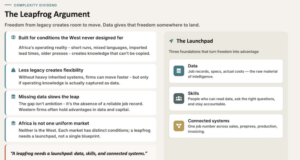
Checkers Sixty60 in South Africa, M-PESA originating in Kenya and Dangote Enterprises from Nigeria proves to us that industries that can build locally relevant models understand how to get the best of data, how to leverage skills and how to build connected systems.
‘So the question is, what can we learn from them and what can we apply into the printing sector, such that we can also demonstrate the fact that we’re able to take complexity and turn it into value?
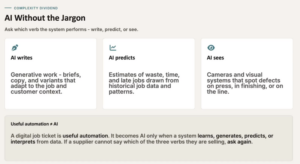
‘Let’s take a step back and establish what AI needs to be without the complexity of the jargon and all the language that we use in our world.’
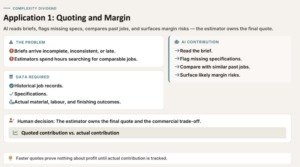
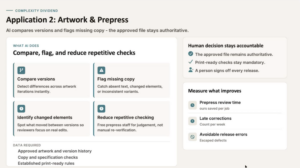
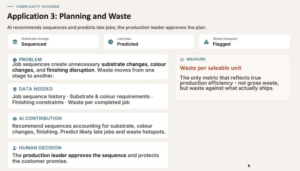
‘There’s some places where human beings will be making the decision, and the importance of understanding where AI makes the decision versus where human beings make the decision, is looking at this decision landscape that we use to be able to demonstrate who decides when important decisions need to be made.’
There are four types of decisions that are defined by either high ambiguity or low ambiguity, or high risk or low risk.
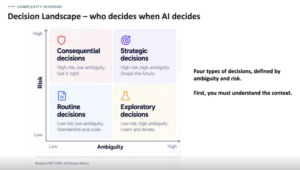
‘What’s also key to understand is no matter which quadrant you fall into, the role of the human is still critical and crucial to us in terms of maintaining value.
‘People are closest to the process and they can make AI safer. They can help us to understand guardrails that need to be in place, but also they can use their history, experience, and judgement to be able to pick up on patterns that inform a safeguard.’
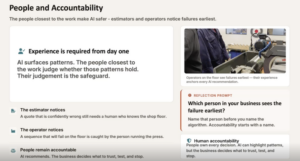
‘What’s also important in the age of AI is the mix of people you have in your organisation. Intergenerational dynamics mean that you need young people who are native to some of these technologies, can ask the right questions, can see around corners, and can get excited about new and interesting things. But one truly also needs a balance of the older generation, so to speak, that bring the knowledge, the wisdom and the application. And where those two worlds intersect is really where the magic lives.’
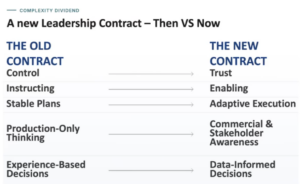
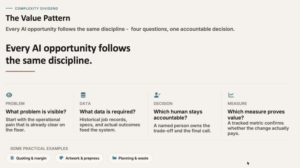
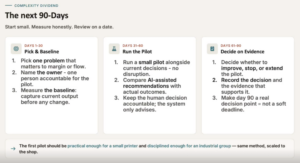
‘How do we start small? How do we measure honestly? And how do we review in such a way that we can iterate? This very simple process will allow you to be able to implement something tomorrow hopefully, and through that be able to gain value in the next 90 days.
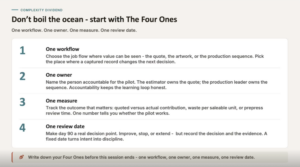
‘The last thing I’d leave with you is the hope and the encouragement that some of these changes can be very onerous and they can feel like it’s a lot to do, so don’t start by thinking about how you’re going to boil the ocean, start with these four measurements.
‘I hope you’ve been able to appreciate that, despite our complexity as a continent within the the printer sector, it really represents an opportunity.’
| LOCAL DISTRIBUTOR PRINTING SA Tel: +27 11 287 1160 Email: info@printingsa.org Website: http://www.printingsa.org  |