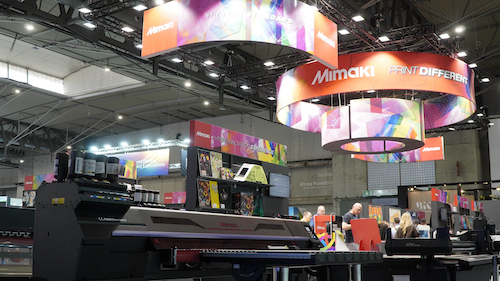
Mimaki Europe brought its ‘Print Different – Powering Possibilities’ theme to life, demonstrating how digital printing technology can turn ideas into high-value applications and new business opportunities. Mimaki conveyed its customer-led innovation strategy through an application-focused stand concept, built around dedicated ‘Experience Areas’ spanning hybrid UV, sign and graphics, textile, personalisation and high-volume production.
At FESPA Global Print Expo 2026, which took place in Barcelona from 19-22 May), each area offered live printing, finished samples and workflow demonstrations to show how Mimaki solutions can support application diversification, production flexibility and business growth across different segments and materials, while reflecting the company’s commitment to innovating with purpose.
‘At FESPA 2026, we wanted to show customers not only what our technologies can do, but what they can make possible,’ commented Danna Drion, General Manager Marketing and Product Management, Mimaki Europe. ‘Print service providers are looking for tangible ways to expand their offering, improve efficiency and respond to new market demands. Our stand was built around those needs, with live applications and workflows that mirrored real production environments, so visitors could see how Mimaki innovation could help them diversify with confidence.’
A key focus of Mimaki’s presence at the show was the continued expansion of UV printing into new application areas. Showcased for the first time at an international show, the recently launched UJ330H-160 hybrid UV printer was featured on the booth’s Hybrid Innovation Experience, demonstrating how one technology platform can support both roll-to-roll and rigid applications. Designed to help customers increase production versatility, without adding unnecessary complexity, the UJ330H-160 enables print businesses to explore applications and move seamlessly between signage, interior décor, display graphics, packaging and point-of-sale.
Early customer feedback on the UJ330H-160 is already highlighting the value of combining roll and rigid production in one system, particularly for businesses looking to reduce outsourcing, optimise production space and expand into new application areas.
Another highlight was the UJV200 Series making its international tradeshow debut at FESPA. Developed to make high-quality UV roll-to-roll printing more accessible, the UJV200 Series supports a wide range of sign and graphics applications, combining Mimaki image quality with the creative possibilities of UV printing, including white and clear ink effects.
Arjen Evertse, Director Sales, Mimaki Europe, commented, ‘UV printing is becoming an increasingly important growth driver for print businesses, enabling them to work with a broader range of media, expand into new applications and respond faster to customer demands. With the UJ330H-160 and the UJV200 Series, we showed two different ways Mimaki is supporting this evolution: one through hybrid versatility across roll and rigid production, the other through accessible, high-quality UV roll-to-roll printing.’
Mimaki is also continuing to evolve its DTF technology in line with the changing needs of the market, as customers look for more stable, scalable and production-ready workflows. At FESPA 2026, this ongoing development was reflected in a new DTF concept model, based on the company’s 330 platform, demonstrated on the stand, offering a preview of Mimaki’s direction for the next generation of DTF production.
‘DTF printing is entering its next phase of maturity,’ added Evertse. ‘Customers are no longer looking only for an entry point into the technology; they want predictability, productivity and consistent colour as they scale up. Through our continued development in this area, we are focusing on the priorities that matter most to the print industry, creating DTF systems that are robust, repeatable and fit for the future.’
Mimaki’s stand also integrated its wider portfolio across signage and graphics, textile, industrial applications and personalisation, showing how complementary hardware, software and workflow tools, including RasterLink and PICT, can combine to form complete, efficient production systems.
|
LOCAL DISTRIBUTOR |