Gulfiia Malakhova, CEO and co-founder, Buzzblender, and writing for Digital Signage Today, said that digital signage continues to expand across retail, hospitality, healthcare and corporate environments. The global market is on track to exceed $45 billion by 2030. But growth in hardware hasn’t translated into growth in effectiveness.
Many networks look modern, but few perform that way. The issue is not infrastructure, it is execution, specifically user experience (UX). Too often, digital signage is treated as a content distribution tool rather than what it actually is: a real-world communication interface competing for attention in busy environments.
Based on what we are seeing across deployments, here are five UX issues that consistently limit performance, and what operators can do about them.
1. Too Much Content, Not Enough Clarity
A common mistake is trying to maximise screen ‘usage’ by fitting in multiple messages, images, and videos, essentially trying to show everything at once. In practice, that reduces impact.
Most viewers engage with signage for only a few seconds. During that time, they’re not reading, they’re scanning. If the message is not immediately clear, or if it feels overwhelming, it gets ignored.
Effective networks simplify:
– One message per screen.
– Short headlines.
– Strong, clear visuals.
– Around 15–20 seconds per screen.
That is often enough to drive results. For example, people eat with their eyes. Juicy add-on visuals, like sauces, bacon, or melted cheese, can increase the average check by around 10%. You do not need complex videos with people. Showing the product clearly at the right moment is more effective.
2. Content Is Not Designed For The Environment
Digital signage doesn’t exist in a vacuum. It lives in physical spaces with different conditions:
– Distance from the screen.
– Lighting.
– Movement.
– Dwell time.
Yet content is often reused across locations without adaptation. For example, messaging designed for a waiting area (longer dwell time) will underperform in transit or storefront environments where attention is measured in seconds.
3. Motion Is Overused
Animation is a powerful tool but only when used with intention. In many cases, screens cycle too quickly or rely on excessive motion that competes with the message itself. If key information is not visible long enough, it simply does not register.
A more effective approach:
– Keep transitions simple.
– Ensure core messages remain on screen for several seconds.
– Use motion to direct attention, not decorate content.
– This is especially important in high-traffic environments where timing is critical.
4. Engagement Opportunities Are Missed
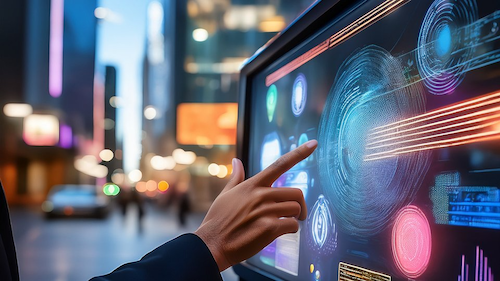
One of the biggest shifts in digital signage is the move from passive viewing to active engagement. However, many deployments still function as one-way channels. That is a missed opportunity.
With the widespread adoption of mobile, simple tools like QR codes can connect physical screens to digital experiences: promotions, product information, or transactions.
Importantly, this no longer requires complex infrastructure. Generate QR-based interactions directly within your digital signage platform.
5. Content Strategy Driven Internally, Not Externally
In many organisations, digital signage becomes a shared channel for multiple stakeholders. The result is familiar: crowded screens with competing priorities.
High-performing networks take a different approach. They define:
– A clear objective for each screen.
– Ownership and governance.
– Success metrics tied to user behaviour.
Instead of asking, ‘What do we want to show?’ They ask, ‘What does the viewer need right now’? That shift makes a measurable difference.
This article appears in Digital Signage Today.