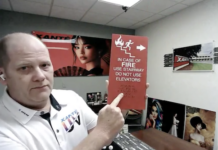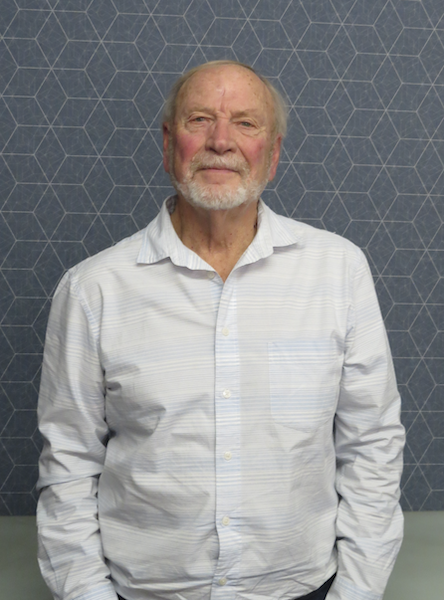
Richard Bell is not only known for his role as Intamarket’s New Business Development Manager. His career in the printing industry spans over six decades, and he continues to provide businesses with innovation — driven by his passion and creativity.
Early Life
Bell was born in Belgravia, Johannesburg into a bustling family of seven. His father insisted that all his sons do a trade. ‘I was top of my class in Grade 10, and wanted to do a bit more, but that wasn’t in the plan. So through a family friend I got into lithography,’ he said.
He joined Rand Litho at 16, initially with no real passion for the job, but over time he developed a love for printing and passed his trade test.
However, on his 18th birthday, he was conscripted. He completed nine months of military service, during which he acquired a strong sense of discipline. Rand Litho closed down soon after this. ‘The Printing Union then arranged for my apprenticeship to be transferred to Cape & Transvaal Printers in Malvern, Johannesburg.’
All apprentices had to attend night school at Johannesburg Technical College, where they achieved the equivalent of a matric level pass.
Bell soon realised that the industry was as much about people and relationships as it was about machines and ink. He then joined Penrose Press as a lithographer, during which time he got married. ‘I’m still happily married despite some fascinating and scary life challenges,’ he said.
He worked overtime, tackled deadlines and moved into managerial roles, which taught him to ‘think out of the box’, particularly when handling annual financial business reports for the stock market.
He accepted his first job as a salesman in graphic arts products for Croda Inks. ‘It was an easy start, as I was totally familiar with litho plates, blankets, dampers and other products, and within six months I was promoted to graphics arts manager.’
How did you get into starting a business?
‘Around that time I had my first child and life was good — there was no overtime, I had a company car, and entertainment allowances, which were fun.’ He added that his business life continued to centre around problem-solving and decision-making, particularly in high pressure situations. ‘But after two years I asked myself: why am I doing all of this, without having my own business? So in the latter half of my twenties, I used my pension to fund my own business called Bell Polyester, based in the south of Johannesburg. For many years, whatever I touched just turned to gold.’
‘It was the right place at the right time. I had the trade behind me, along with the right agencies, and the company blossomed. Bell Polyester became Bell Graphics, and we started converting our own materials. I was always involved as a salesperson, and the company expanded exceptionally well, so much so that after all those years I started thinking I would retire at 45, because I had everything I wanted. But I was getting tired of the month-to-month routine — it was pure monotony.’
He visited factories in the UK and Europe and secured distribution rights to state-of-the-art industry equipment, such as high-end laminators, which at that stage were among the best in the world.
He then became interested in merging the operation into larger entities. He sold his factory, and merged Bell Graphics into another company. However, things did not work out.
‘We did still however have a branch called Pretoria Graphics. Title Contender World Championship Boxer, Charlie Weir, worked for me, and the branch was doing very well. It was perfect and I thought I was just going to coast along while I worked out my restraint of trade agreement.’ Sadly, Weir contracted cancer and died within 10 months.
The whole business was ultimately lost, and Bell, who was 48 with two children, was as poor then as he was at 16 when he first started working. However, he emphasised that the industry has always been good and forgiving, and he had by then moved onto Maple Leaf Graphics as a junior rep for his opposition, which he described as ‘humbling’, but he never missed a day’s work.
He received other business offers while going through financial rehabilitation, and eventually became a partner at Keymark Media. ‘We did very well. I was by then rehabilitated, was a home owner again, and life was once again good.’
By 2018, Keymark Media shut down after 25 years due to there being no family members who wanted to come into and continue the business. ‘The lesson learnt from shutting down Keymark (we had just ticked off our 25th year, so everything we did was done properly) is that you need to plan succession.’
You experienced business challenges and having to start over again. How did you get through these tough times?
’It’s among the hardest things that many of us in the industry can ever face. It’s humbling, and it’s belittling. In this case, we were sequestrated. We lost our home as well as my in-laws’ home. By then I had not one cent to my name — it was tough. But then having to start over was interesting, because I have a strong drive to survive — you have to at that stage in your life.’
‘I also have faith and there were many industry friends who helped me tremendously. We serviced our clients as well as we could right to the end and many of them went out of their way to help us, and that actually led to future job offers.’
‘There was no option but to give it another go, and with family dependent on me, that’s what I did.’
How did you find your way to Intamarket Graphics?
Bell had by then built a strong relationship with Intamarket Graphics. The company approached Bell, who was well over retirement age, and asked if he wanted to join in the new business development to bring in equipment.
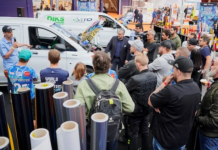
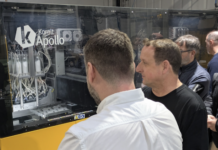
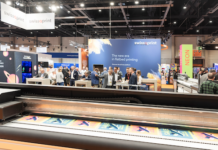
‘They took over a few of my other laminating agencies, some of my staff members joined, and some of them are still with me. This has been the best seven years of my life. I’m not the boss anymore — for the first time in many years. But I love it, and I love the industry. The biggest happiness for me is that I look around, especially at the Sign Africa Expos, and I watch ‘my children’ from the industry — people who I’ve grown up with, who started learning the trade with me, and who’ve got the same passion that I’ve got, and I see how they’ve grown locally and internationally, as heads of companies, as big players, and managers. That mentorship — the chance of growing the next generation — has been good.’
What is your advice on running a successful printing/signage supply business?
‘Passion is number one, because it’s a mixed industry, with all aspects of printing and signage. You need different people. Signage people are different to screen printing people, who do things differently to lithographers. But we create something out of nothing all the time. It’s colourful and exciting. The technological development has been phenomenal. We print onto almost anything these days from food to vehicle wraps. If printing is not your passion, then you shouldn’t be in the industry. My biggest joy is to mingle with international suppliers at the Sign Africa expos.’
‘You also need to form an intimate marriage-like relationship with your suppliers. You need to trust each other, and that makes it worthwhile because when times are tough, you need them, and they need you.’
‘Print creates wealth. If you have the work coming in, manage your productivity properly, reduce wastage, bill correctly and don’t overspend, you will make money — it’s a dead certainty.’
He added that he also loves and respects his opposition. ‘NSI-4-Africa’s Ken Bezuidenhout, Midcomp’s Rob Makinson and myself are always arguing about who will be the last man standing at the expos. They’ve done very well to be where they are.’
What has been the biggest highlight/s of your career, and why?
Bell spoke fondly about the people he’s met and friends he’s made along the way. ‘Every call that I made was a point of excitement, because you interact at a personal level. It’s not just a case of making a sale, it’s helping people to create wealth with the equipment we supply.’
Who has been your greatest inspiration?
Bell said among the people who had the greatest influence on his life was Nolan Weight from Stonehouse Graphics. His business even won the ‘best printing company in the world’ title in an international competition. ‘We became close business friends. He was a guide and a mentor, but sadly passed away last year.’
Other mentors include Glen Wagner as well as Justin Hawes, owner / MD of Scan Display. ‘Hawes is very entrepreneurial, and a good human being. Bell also described Gavin Turner, MD of Intamarket, as a ‘trustworthy and honest person, a very special human being and very special friend.’
What makes the South African printing industry so unique and exciting compared to other parts of the world? What challenges do we face?
‘It’s diversity. I always say to international suppliers that we’re in this mix of first, second and third world in Africa. We’ve got the best and the worst of all aspects, and from that, we’ve had to learn to cater for all these different segments of the market, which has made us really unique.’
‘It’s about the ability to innovate, and to survive crises such as COVID, just as this industry can survive anything. It’s like the Bokke, you just get in and you make it happen. It’s our flexibility and adaptability as a nation, which we are lucky to have. It’s also about the unpredictability — you have to be fast on your feet. You’ve got to move, and keep moving.’
In terms of challenges, he emphasised the need to get back to proper training. He mentioned introducing a training college, much like what has been undertaken by Printing SA, but with a demonstration room to train people on the equipment, and to bring in overseas expertise and visiting experts.
‘Give people proper credentials,’ he said. ‘They can then enter the market with internationally-renowned certifications recognised by global suppliers.’
Signage and technology changes
He said that the biggest change has been the industry’s immense transition from analogue to digital. He also commented on how technology has evolved. Starting off in litho, he has seen the industry adapt to solvent printing, and UV technology soon after.
‘Technologies have changed. Everything is on computers, and I love AI,’ he said, adding that he often speaks to suppliers to determine what the next need is, and what the next pain point will be. ‘I love walking into a factory and smelling print and seeing the ways it can be improved. I always ask: what can we do to change the industry? I like to grow and develop things once they’re established.’
Hobbies
Bell has been a keen motorsport enthusiast since the age of five, having been raised in a motoring family, with a father who sold motorbikes.
He and his siblings raced bicycles in the streets, and later in his thirties he became a radio-controlled car champion of South Africa, having taken it up as a hobby.
Bell plans to retire in July 2026 — at the age of 80 — but he plans to keep busy. ‘I’ll probably continue to get involved in church activities. I’m involved now in cancer support groups. I very much enjoy Parkruns. It’s good to be out every week.’ He added that he is blessed with a good family and support.
Final Thoughts
‘A lot of people say that I take on more than I can chew, but I’ve always worked and played hard. I’ve always had an intense competitive streak and enjoy that aspect of overdoing everything. Just make sure your targets are high, and if you don’t succeed at first, you can still aim for pretty reasonable targets.’
|
LOCAL DISTRIBUTOR |