Gerry Price, President and CEO, North America, The Look Company, and writing for Digital Signage Today, says a data-focused approach to in-store holiday visuals and displays lets retailers make informed decisions about aspects of the shopping experience they’ve traditionally relied on instinct alone to implement.
Imagine walking into a retail store during peak holiday shopping season and discover that, this year, they’ve decided not to put up any holiday visuals. No red, no green, no gift-wrapped box displays, or festive bows not even a hint of snow, snowflakes or snowmen. It’s any other day, even though it’s December.
Needless to say, this would feel like an alternate universe to even the most passive shopper.
For the retailer, it would be a very quick way to get clarity around an age-old retail paradox, ‘We know we need holiday visuals and displays. But we don’t know the value of them’.
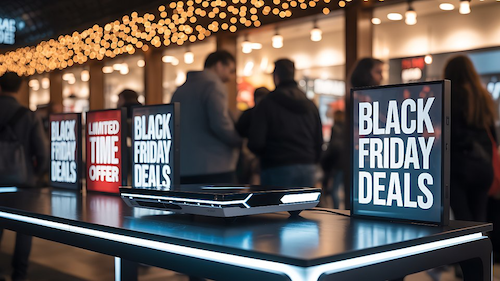
But retailers don’t need to go to this extreme to understand that a thoughtfully-crafted holiday atmosphere benefits them. After all, appealing window displays alone are estimated to boost in-store foot traffic by 23%, while in-store displays are estimated to inspire from 80% to 478% more spending.
Here’s how to make effective visual decisions by using and creating quantitative data at the intersection of shoppers’ in-store behaviours, sales and in-store product and display placements:
1. Use data you have to determine locations, themes performed best and create more
Retailers might assume they don’t have a lot of data about their visual displays, especially when it comes to non-digital installations, but they have more data than they think. For instance, they can use sales data to map out the most highly trafficked areas and highest converting product placement zones. From there, they can determine which displays and visuals were used in both last season.
Similarly, they can look at low traffic areas and product placement zones, and map out which visuals were used there.
While this is not an exact science, doing this can offer correlational insights into which display types, themes, graphics, copy and store locations contributed to driving shoppers to the highest performing products and ultimately, their purchase.
2. Introduce digital elements that extend experiences while offering new engagement insights
Nearly every shopper has a smartphone, which enables them to interact with displays on a deeper level. Retailers have tapped into this new reality by introducing elements like scannable QR codes on printed visuals to extend the in-store experience virtually and electronic visual displays that change based on a given shopper’s preferences to create a more personalised experience.
These digital installations don’t just keep digitally native shoppers engaged though, they can also collect behavioural data that tells retailers what’s working and what’s not – long before next season.
Location-based sales tools, such as in-store digital coupons also offer a better understanding of who’s shopping in real time, which offers brought them in, and which products they’re buying in addition to the original advertised items.
3. Holiday season is long and social media trends are quick, make sure some displays can change on the fly
Retailers that integrate digital elements into their print displays or offer completely digital experiences will potentially begin gaining data immediately. Depending on what they learn about users’ interactions with their displays and the resulting sales (or lack thereof), it’s unlikely they’ll want to wait until next season to act on it. The good news is that they don’t have to.
By introducing SEG fabric and adaptable frames, which have unlimited design flexibility, retailers are empowered to update visuals to reflect what they’re learning, or simply refresh displays so that regular shoppers don’t have the same experience all season long.
Similarly, social media trends tend to pop up out of nowhere without warning. For retailers, this can mean quickly curating product assortments that bring together items associated with the trend.
But building spur-of-the-moment collections is only step one. Making sure shoppers know about them the moment they walk through the doors is step two. Retailers who include a range of customisable physical design options in their visual plans will be able to do both.
This article appears in Digital Signage Today.