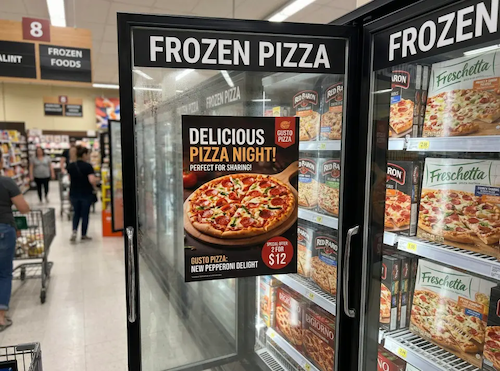
Frank LaMacchia, Wide Format Specialist at Lindenmeyr Munroe, and writing for Drytac, oulines that from bold promotional graphics applied to the outside of freezer doors to protected visuals installed on the inside of the glass, these applications are now common across grocery, convenience, and big-box retail environments.
Despite their popularity, freezer doors present unique challenges. Temperature, condensation, surface selection, and adhesive performance all play a critical role in success. Understanding the difference between first surface and second surface applications is essential to achieving reliable performance and clean removability.
First Surface Applications: Outside of the Glass
First surface applications are installed on the exterior-facing side of the freezer door, the surface customers see and touch. While these graphics are associated with freezer environments, the glass itself is typically exposed to ambient store temperatures. Regular door openings, store HVAC systems, and customer interaction all help moderate surface temperature, making first surface applications less extreme than many assume.
Because this surface is exposed to cleaning, abrasion, and frequent handling, the ideal material must balance durability with easy installation and removability.
Second Surface Applications: Inside of the Glass
Second surface applications are installed on the inside of the freezer glass, facing the cold interior. These graphics benefit from protection against customer contact and cleaning chemicals, but they are continuously exposed to sub-zero temperatures. As a result, adhesive performance and film flexibility become significantly more critical. For these applications, materials must be specifically engineered to perform in cold environments.
Temperature: The Most Common Misconception
One of the most frequent misunderstandings surrounding freezer door graphics is the assumption that the application surface is always at freezer temperature. While freezer air may reach -20°C, the glass surface, particularly on first surface applications, is often much warmer.
Regardless of the material used, proper handling is critical. Graphics should always be stored and installed at room temperature and applied while fully climatized. Attempting to install cold, brittle material directly from a freezer environment significantly increases the risk of poor adhesion, cracking, or long-term failure, even with cold-rated films.
Material Selection And Removability
Freezer door graphics are often installed for short to mid-term promotions, making clean removability a key requirement. Selecting the correct adhesive system from the outset helps ensure graphics can be removed without residue or glass damage.
First surface applications benefit from removable films, depending on durability and temperature exposure. Second surface applications require engineered cold-temperature solutions to ensure consistent performance throughout the campaign lifecycle.
When the correct material is paired with proper installation practices, freezer door graphics can be removed cleanly and efficiently, even after extended exposure.
Installation Considerations That Matter
Successful freezer door applications are the result of both the right material choice and sound installation practices. Confirming actual glass surface temperature, avoiding heavily frosted or wet glass, and allowing adequate dwell time before returning doors to normal operation all contribute to consistent, repeatable results, especially across multi-store rollouts.
Final Thoughts
Freezer door graphics offer exceptional impact at the point of sale, but they demand a thoughtful approach. By understanding the differences between first and second surface applications, recognising real-world temperature conditions, and selecting materials designed for the environment, printers and installers can deliver graphics that perform reliably and remove cleanly.
MIDCOMP
+27 10 020 9999
consumables@midcomp.co.za
www.midcomp.co.za