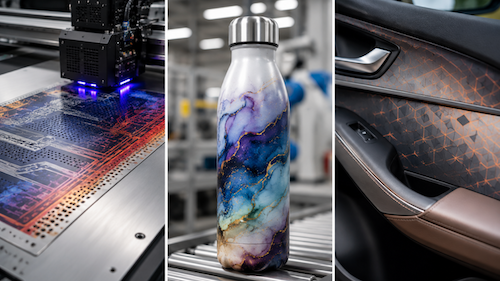
Ilisna Lane, sales manager at NUtec Digital Ink, writes that the graphic arts market remains an incredibly important part of our industry, but only one chapter of a much bigger story. When people think about digital printing they think about banners, vehicle wrapping, point of sale graphics or billboards. The reality is far bigger.
Digital inkjet technology has transformed manufacturing in ways that many people never see. Today, inkjet is decorating furniture, personalising consumer products, printing directly onto industrial components, decorating ceramic tiles, custom packaging and even contributing to medical applications.
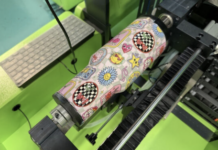
One of the fastest-growing areas is direct-to-object printing. Instead of printing onto a self-adhesive film/label that is applied later, manufacturers are now printing directly onto the finished product. The possibilities continue to grow as demand for UV-curable inks and automation ramps up.
The result? Fewer production steps, greater flexibility and the ability to customise products without slowing down manufacturing. This takes us to industrial printing that is less about making something look attractive, and more about adding value. Digital printing is now being used to manufacture products that need to perform.
Applications include: decorative laminates, ceramic tiles, flooring, leather decoration, flexible packaging, automotive interior panels, membrane switches and the list go on. Each application has its own technical challenges, requiring inks with specialised properties such as adhesion, flexibility, chemical resistance, UV durability, heat resistance or outdoor performance.
This is where industrial printing becomes a fascinating combination of chemistry, engineering and manufacturing.
Why It Matters
There is an increasing demand for products to be personalised; shorter production runs to be economical and designs to change quickly. Traditional manufacturing methods often struggle to keep up. Digital inkjet changes that equation by allowing manufacturers to produce exactly what they need, when they need it, with minimal waste.
It is not simply replacing analogue processes. It is enabling printing of products that were previously impossible, or commercially impractical to manufacture.
The Future
As printheads become faster, inks become more specialised and automation continues to improve, we will see digital printing integrated into even more manufacturing environments. For many businesses, digital printing is no longer just a way to decorate a product. It is becoming part of the production process itself.
The next time someone mentions digital printing, do not just think about posters and banners. Think about the thousands of products around you that may have been manufactured using inkjet technology, and you probably never even realised it.
C1W Initiative
Change 1 Woman (C1W) aims to empower women in the branding, print and signage industries. As part of this initiative, Sign Africa would like to spotlight women-focused content like this piece. If you have any trend/business articles related to the signage, branding and printing industries, please email content to: meggan@practicalmedia.co.za. Follow C1W on Facebook and LinkedIn for more updates.
| MANUFACTURER NUTEC DIGITAL INK Tel: +27 21 763 6990 Email: info@nutecdigital.com Website: http://www.nutecdigital.com  |